

As organisations scale, payroll accuracy becomes harder to protect. Not because the underlying calculations change, but because the volume of data feeding into them does.
More entities, more systems, more edge cases. The manual checking required to keep pace is growing faster than most payroll teams can hire for. That's the gap AI payroll tools are stepping into: not a blank-slate reinvention of how people get paid, but a targeted response to operational pressures that have been building for years as enterprises scale.
The question worth asking is not whether AI in payroll is coming. It is already here, in production, at scale. The more useful question for payroll, HR and finance leaders is what it is actually doing and, just as importantly, what it is not doing.
A lot of what gets called AI in payroll operations in vendor marketing is really just payroll automation with a new name on it. The real shift is in the layer that sits around payroll's core calculation — the part that used to depend entirely on a person noticing something was off. Anomaly detection is a good example: instead of a payroll specialist manually scanning a report for a pay code that looks wrong for the period, AI can flag the variance before it goes any further, so a human still makes the call, but they're making it on a shortlist of real issues instead of hunting through a full dataset. Compliance checks work the same way, catching a mismatch between a data upload and expected formatting in real time, rather than during a manual review days later, or worse, after payday.
None of this touches how pay is actually calculated. That part stays exactly what it's always been: deterministic, rules-based, and repeatable without exception, every single time. Payroll has zero tolerance for a system that occasionally guesses. What's changing is everything that used to rely on a person catching a problem manually.
That does not mean "AI now runs payroll." It's closer to "AI now checks payroll's work," catching anomalies and flagging exceptions before they become problems, so the human specialists running payroll can spend their time and judgment where it actually counts.
Reporting is another area this plays out in practice. Enterprise payroll teams are routinely asked to provide numbers: 'headcount cost by department this quarter', 'how a benefit's uptake has shifted since the last pay review', 'which cost centre absorbed a particular pay run's overtime spike.' These are exactly the kinds of questions AI is well suited to answering quickly, because they're data-retrieval and pattern-matching problems, not judgement calls.
The same logic applies to exceptions, not just totals. A payslip with a missing date of birth that would cause an FPS submission to fail, a new starter already auto-enrolled into a pension scheme, a salaried employee with no salary line at all — these are the errors that used to surface only when someone happened to spot them, often after the payslip had already gone out. Flagging them before submission isn't a judgement call either. It's pattern-matching against known failure modes, applied consistently, at a volume no team could sustain by checking manually. This is where AI can truly help enterprise payroll operations.
How to put AI to work in payroll operations: A practical example
Most organisations offer more employee benefits than most employees actually claim — a pension match that's under-utilised, a savings scheme nobody signed up for, an entitlement that got explained once in an onboarding pack and never mentioned again. That gap is not usually a flaw in the benefits themselves, but an information problem. In practical teams, this means it's nobody's job is to notice who's leaving something on the table.
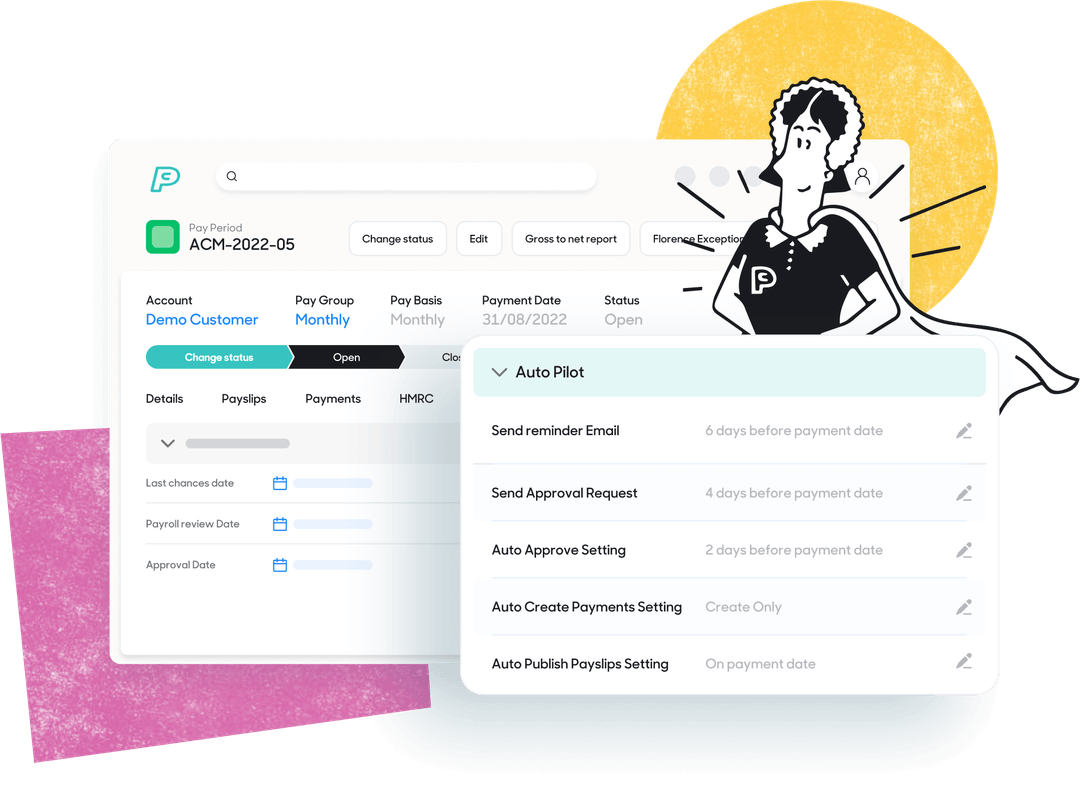
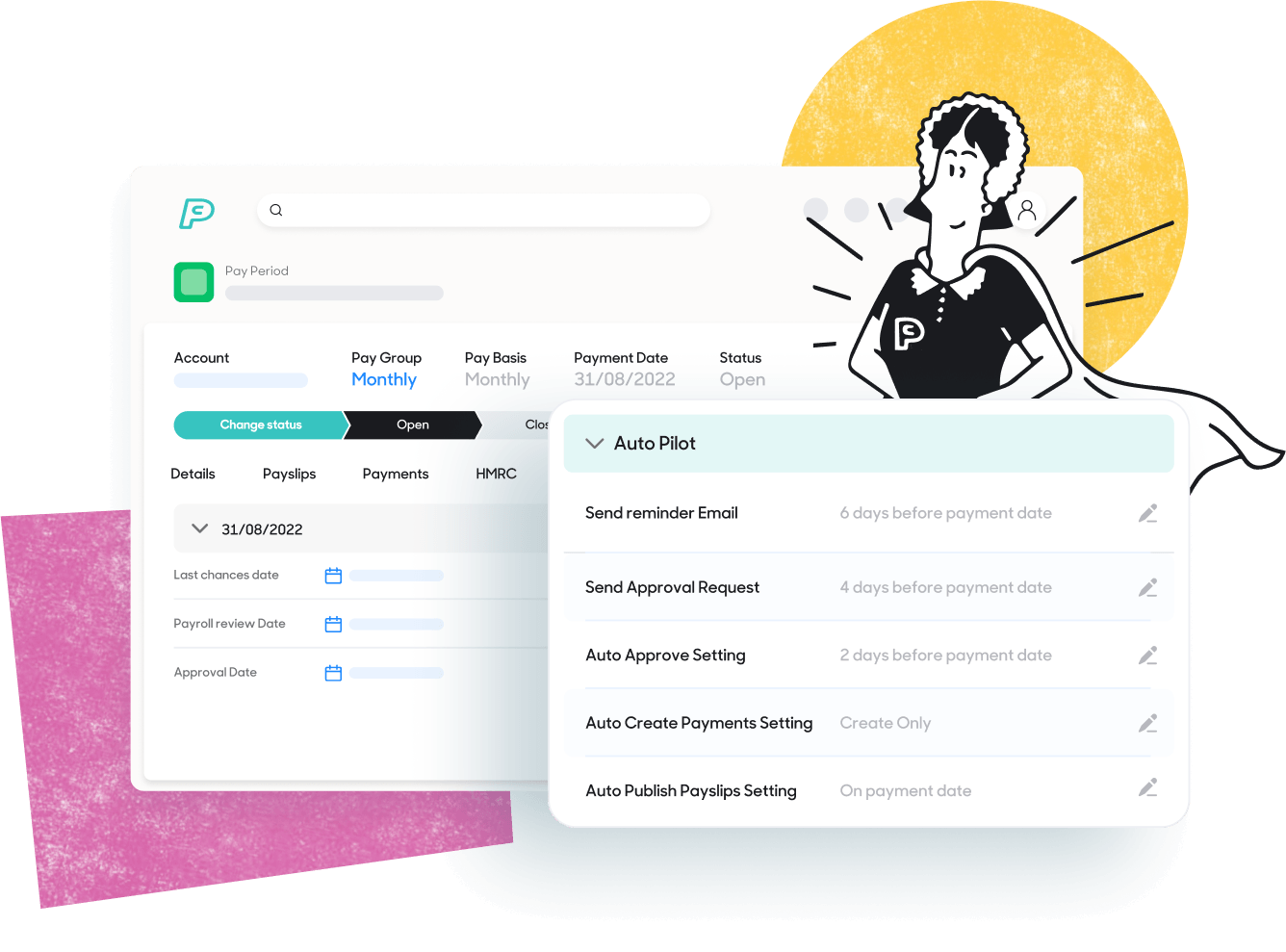
At PayCaptain, our AI-powered payroll assistant, Florence, does exactly that kind of noticing. Florence surfaces entitlements employees are eligible for but haven't claimed, at a scale no HR team could realistically track. Across PayCaptain's customer base, that's already added up to more than £500,000 in identified employee benefits that would otherwise have gone unused.
That's a useful way to think about where AI adds value in enterprise payroll generally: not in the headline calculation, but in the noticing — the pattern checking nobody had time to look for. These anomalies get surfaced automatically, so a payroll specialist can swiftly act on them.
These checks are already running in production across the industry—not as a pilot or a roadmap item. They're specific, repeatable, and easy to state plainly: has gross pay moved more than expected since last period? Have pension contributions stopped for someone still actively enrolled? Is a leaver being paid out at double their normal net pay? Does an hourly rate sit below National Minimum Wage? None of these are judgement calls. They're the kind of checks a diligent payroll administrator would run by hand, on every payslip, every period—if there were enough hours in the day. There usually aren't, which is precisely the gap tools like Florence are built to close.
See how Florence works in action
What AI isn't doing (yet)
AI in this space isn't making autonomous decisions about anyone's pay. It isn't replacing the judgement of a payroll professional who understands the specific compliance context of a business, a sector, or an individual employee's circumstances. And it isn't a substitute for a properly governed, rules-based calculation engine.
The more honest framing is that AI is currently good at a genuinely useful set of tasks: catching what a person would eventually catch anyway, just faster and more consistently, and surfacing patterns across a dataset too large for anyone to scan by eye. At PayCaptain, we've seen this play out internally too—payroll specialists can turn to Florence, our AI chat companion, during processing, to help them answer questions and troubleshoot.
That's the real capability, and it's worth payroll leaders asking their providers a direct question: how are you actually using AI to improve performance and efficiency?
Watch the AI & Payroll webinar
Why AI matters for enterprise leaders
For a payroll, HR or finance leader at an enterprise organisation, the practical upshot has less to do with the technology itself than with where it frees attention to go.
Every hour a payroll team spends manually reconciling data, chasing a discrepancy, or double-checking a report that's grown too large to review by eye, is an hour not spent on the parts of the job that actually need a person's judgement: handling a genuinely unusual case, working with finance on forecasting, or simply having the capacity to explain something properly when an employee has a question. As organisations scale, that trade-off gets sharper- meaning more entities, more employees, more edge cases, and a payroll team whose headcount rarely grows at the same rate as the complexity around them.
That's the actual argument for AI in enterprise payroll: not that it's impressive, but that it changes what a stretched team has time for. It's also a useful lens for evaluating any provider's AI claims, the right question usually isn't "does your platform use AI," it's "what specifically does it catch, and how much of the judgement is still mine." A provider that can answer that precisely is telling you something real about their product.
The future of AI in enterprise payroll
The checks running today such as anomaly detection, compliance flags, benefit-uptake gaps, are all largely reactive. For example, something happens, and AI notices it faster than a person would. The next stage is more anticipatory. Instead of flagging that gross pay moved unexpectedly last period, systems will increasingly model what a given change should look like before it happens, catching a misconfigured pay element or a pension miscalculation at the point of setup rather than after the payslip's gone out.
That shift matters more at enterprise scale than anywhere else. A single payroll error is a fix. The same error replicated across twelve entities, three payroll systems and a handful of newly acquired subsidiaries is a much bigger problem, and it's exactly the kind of complexity that's hardest for a human team to model manually and easiest for AI to hold in view all at once.
None of these changes the argument already made in this piece. The calculation stays deterministic. The judgement stays human. What expands is the range of things AI can be trusted to notice before they become someone else's problem, which is the same principle payroll teams are applying today, just with a wider lens. The providers worth paying attention to won't be the ones claiming AI will run payroll unsupervised. They'll be the ones who can show, concretely, what their systems catch now and what they're building toward next.
Getting that balance right — automation doing the noticing, people doing the judging — is also the question at the centre of PayCaptain's upcoming At the Table discussion, where senior payroll, HR and finance leaders will be getting into exactly this: where AI is genuinely changing enterprise payroll operations, and where the human expertise in the room still has to lead.
Download: 10 Ways to put AI to Work in Payroll (10 practical, no-cost actions payroll leaders can take this week to start engaging with AI)