

Payroll used to be seen as the final step in the employee data journey. HR gathered the people data, payroll calculated the pay and finance recorded the cost. That model was never simple, but it was easier to manage when systems were smaller and workforces were less complex.
In large organisations, this view doesn’t fit with operations. Payroll software now sits between HR, finance, time, pensions, banking and statutory reporting. It takes approved people data from HR and turns it into pay, deductions, liabilities and finance outputs. When it works well, the business can trust the flow of data from employment change to financial record.
The flow of data between solutions is a strategic issue, not just a systems task. A weak connection between HR and payroll can create pay errors. A weak connection between payroll and finance can slow reporting and month-end close.
For enterprise organisations in the UK, payroll needs to be treated as part of the core architecture. It shouldn’t sit outside the HR and finance stack, but should be designed into it. The tech stack needs clear ownership, controlled data flows and integration methods that can cope with change.
How payroll integrations fit into the HR and finance technology stack
In a modern HR and finance technology stack, each system has a defined role:
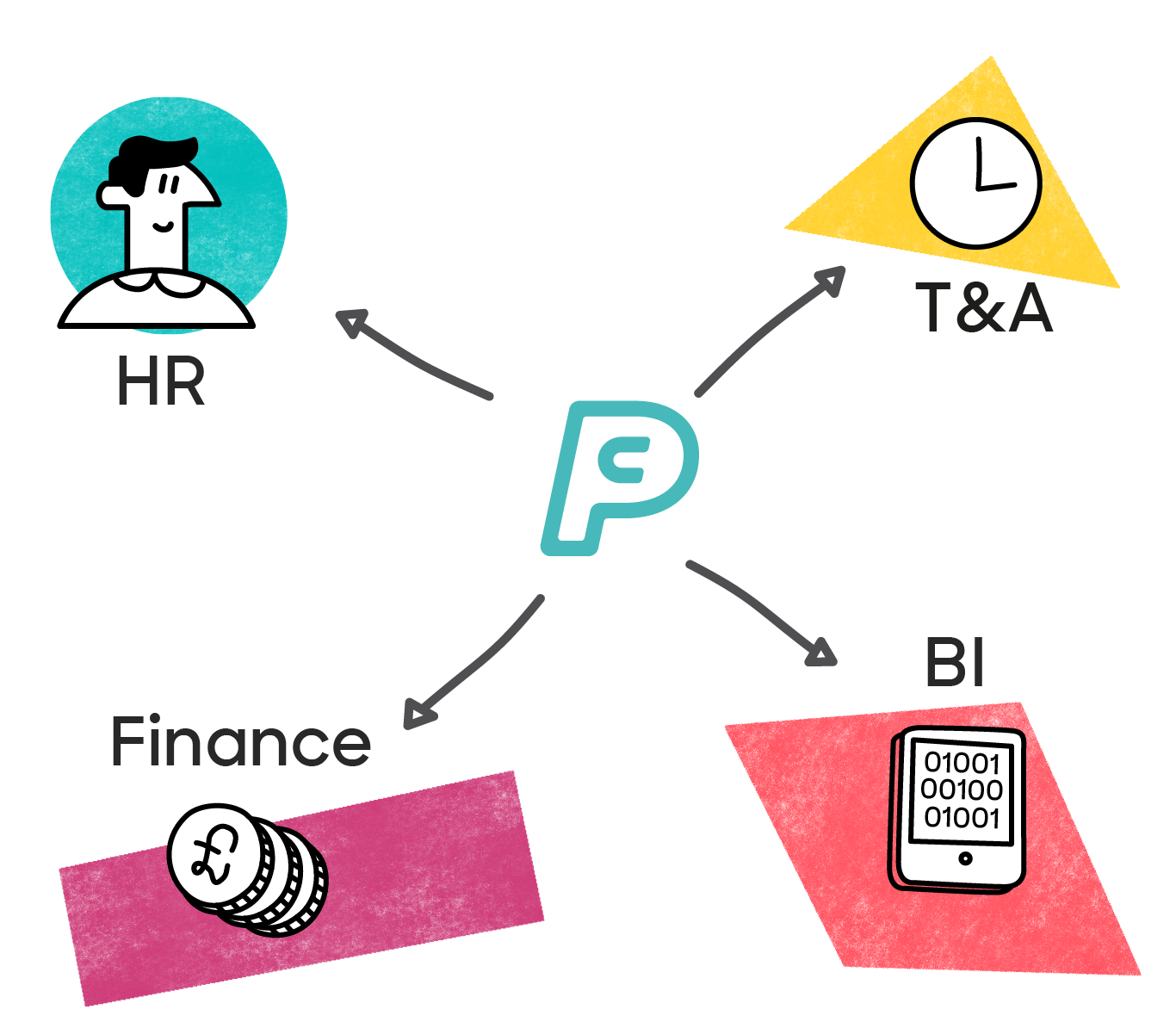
- HR holds core employee data such as starters, leavers, roles, salaries, cost centres and working patterns. It also holds time and attendance, absence management data, contracted hours/ shifts and benefit management information
- Payroll uses that information to calculate pay, tax, National Insurance, pensions and statutory outputs
- Finance then uses payroll data to record costs, liabilities and payments
The value of the stack comes from how well these systems connect. If HR data has to be exported, checked, amended and uploaded by hand, it’s not truly connected. It may have systems in place, but people are still acting as the integration layer.
Payroll is the point where many of these weaknesses become visible. A missing starter, late salary change or wrong cost centre can create a payroll correction. It can also affect finance journals and reporting as well as employee trust. It’s why payroll needs stronger positioning inside enterprise technology planning.
Good payroll integrations help create one version of the truth. HR shouldn’t hold one version of an employee record while payroll works from another. Finance shouldn’t have to rebuild payroll costs from spreadsheets after each pay run. The stack works better when each system feeds the next with approved, structured data.
This doesn’t mean every update needs to happen in real time. Payroll still needs cut-off dates and approval controls. The stronger point is that data should move through agreed routes, with clear rules and evidence. This is what separates a connected operating model from a collection of systems.
For UK employers, payroll also sits within a compliance environment. Payroll needs to support PAYE reporting to HMRC through Real Time Information. It also needs to support auto-enrolment pension processes. These obligations make accurate data movement more than an efficiency issue.
Explore how connected payroll could fit into your HR and finance stack
Common HRIS and payroll integration models for large organisations
There are several ways to structure an HRIS payroll integration. The right model depends on the organisation’s size, systems, change appetite and control needs. It also depends on how far the business wants to move towards a best-fit technology stack rather than one large suite.
[H3] The single suite approach to HRIS payroll integration
One model is the single-suite approach, where HR and payroll sit inside the same wider platform. This can reduce the number of separate connections and may support a common data model. It can work well where the payroll needs are fully covered by the wider suite.
The limitation is flexibility. Large UK organisations often have detailed payroll needs and complex pay rules. They may also have specific reporting requirements. They may want a specialist payroll platform that connects to HR and finance, rather than a payroll module inside a broader system.
How HRIS payroll integration works with HR as the system of record
Another common model is HRIS as the system of record, with payroll as a connected engine. In this model, HR owns approved people data. Payroll receives the data needed to calculate pay, then sends outputs into finance and reporting systems.
This model keeps ownership clear:
- HR owns the employment record
- Payroll owns calculation, statutory processing and pay outputs
- Finance owns the general ledger, reporting and cost control
The integration connects these responsibilities without blurring them.
Middleware as a control layer for payroll integrations
A third model uses middleware or a control layer between systems. This is often useful where the organisation has more than one HR, payroll or finance system. It can also help after mergers, acquisitions or technology change, where systems may not align neatly.
File-based integration still has a place in some environments. A scheduled file can work when data is stable, change is limited and controls are strong. Yet file transfer can become fragile when changes are frequent and checking depends on people spotting issues.
API-first payroll integrations for HR and finance systems
API integration is the stronger direction for modern enterprise stacks. APIs allow systems to exchange structured data through controlled interfaces. They reduce the need for manual uploads and can make data movement more consistent. For payroll, this matters because employee data can change every pay cycle.
Assess your current payroll software with Payroll Pulse
How payroll integrations move data between HR and finance systems
How HRIS payroll integration moves data into payroll
The easiest way to understand payroll integrations is to follow the data. An employee joins, changes role, receives a salary change or leaves. The event usually starts in HR and then needs to flow into payroll at the right point in the pay cycle.
A strong HRIS payroll integration should move payroll-ready data from HR into payroll without duplicate entry. This may include identity details, contract data, salary information, hours, absence, tax details and cost centres. The payroll system then uses this information to calculate pay and produce statutory outputs.
Stable identifiers matter here. If systems cannot match the same employee record across HR and payroll, errors become more likely. The business may also struggle to trace which record was correct at a given point in time.
How payroll integration moves payroll data into finance
Once payroll has run, the data moves downstream. Finance needs a structured payroll journal that can be posted to the general ledger. This may include gross pay, deductions, employer contributions and liabilities, often split by cost centre, department or account code.
Finance teams shouldn’t have to rebuild payroll data after each pay run. They need payroll outputs in a format that fits posting to the finance system and supports reporting.
Payments may also sit within the flow. Payroll outputs can support payments to employees, HMRC and pension providers. The stronger the connection between payroll, finance and payments, the easier it becomes to reconcile what was calculated with what was paid.
The whole flow should be governed. HR should know which data is payroll-relevant. Payroll should know which fields are approved and ready to process. Finance should know which payroll outputs are final and ready to post.
Why payroll integration architecture matters for large organisations
Integration architecture matters because scale changes the risk profile. A small employer may be able to manage a weak handoff with manual checking. A large enterprise can’t rely on a manual approach.
With thousands of employees, the number of HR and payroll changes can rise quickly. Starters, leavers, promotions, location moves, absence changes and pay adjustments can all have a payroll impact. Employees working across multiple locations can also create additional complexity, particularly when costs need to be accurately allocated to the location where work was actually carried out.
In the absence of effective integration, these changes may move through emails, uploads and manual checks, making it harder to maintain accurate costing, reduce manual cross-charging and prove that the right controls are in place.
Architecture defines whether systems connect directly, through middleware or through scheduled files. It also defines how errors are flagged, who owns corrections and how evidence is kept.
Poor architecture creates hidden work:
- Payroll teams spend time checking files rather than reviewing exceptions
- Finance teams rebuild journals rather than analysing costs
- HR teams answer repeated queries about data that should already have moved
API-first architecture can reduce this pressure. It allows approved systems to share data in a structured way. It also gives organisations more room to adapt when departments change, new entities are added or finance structures are updated.
It matters for automation too. Automation only works well when the underlying data is reliable. If data is incomplete, duplicated or poorly mapped, automation simply moves mistakes faster.
The same applies to AI-payroll software. AI tools within payroll will flag anomalies, unusual pay movements or missing information. But they depend on trusted data flows. Weak integration limits the value of any more advanced technology added later.
Architecture should never be left only to IT.
Payroll, HR and finance all need to be involved because each team understands a different part of the risk. Together, they can define which system owns each field, when data moves and what happens when something fails.
Talk to PayCaptain about building a more connected payroll process
Why disconnected payroll systems create risk for large organisations
Manual payroll calculations increase the risk of errors
When HRIS and payroll systems aren’t integrated, the first problem is usually manual work. HR exports data, payroll checks it, finance rebuilds it and teams spend time reconciling differences. The process may still function, but depends heavily on effort.
It creates a false sense of control. People feel reassured because checks are happening, but the checks are often compensating for weak system design. At scale, this isn’t a strong control environment. It’s a process held together by knowledge and memory.
The most visible risk is incorrect pay:
- A late change can be missed
- A cost centre can be wrong
- A leaver can remain active too long
These issues affect employees directly and can damage trust in the payroll process.
How disconnected payroll and finance systems affect journal accuracy
When systems aren’t fully integrated, there’s a finance risk. If payroll data doesn’t flow cleanly into the finance system, journals may need to be created manually. This slows reporting and increases the chance of misstatement. It also makes labour cost analysis harder than it needs to be.
Outsourcing doesn’t remove this issue. If the integration model is weak, manual work may simply move to another team or provider. The organisation may still face late data, unclear ownership and extra checking every cycle.
Poor or missing payroll integrations affect employee experience
Poor integration also affects employee experience. Employees expect systems to feel joined up. They expect changes to be reflected correctly and pay information to be accurate. When systems don’t connect, employees feel the impact through errors, delays and repeated queries.
For payroll professionals, disconnected systems are frustrating. Technology should help them spend more time on judgement, review and improvement. It shouldn’t leave them acting as the bridge between HR and finance.
Review your payroll integration model with PayCaptain
How payroll integrations build connected HR and finance ecosystems
How payroll integrations improve system connectivity
Modern payroll platforms are built to sit inside a wider ecosystem. They need to connect with HRIS, finance, ERP, time, pension and payment systems. The strongest platforms make these connections part of the operating model, rather than treating them as extra technical work.
This reflects a wider shift in HR and payroll technology. Buyers aren’t just looking for standalone products. They’re looking for systems that can work with the rest of the stack and support future change.
API integration plays a central role. It allows payroll to receive structured data from HR and send structured data into finance. It can reduce manual handling, improve timing and support cleaner evidence.
Pre-built connectors can also help. They reduce the need for bespoke development and make implementation easier to manage. This can be useful for enterprise organisations that need to connect payroll to several systems without creating fragile one-off links.
How payroll integrations improve exception handling
Modern payroll platforms should also support strong exception handling. Integration isn’t just about moving data when everything goes well. It’s about showing teams when something is missing, late or inconsistent.
The systems payroll should connect to will vary by organisation. Most large UK businesses should consider HRIS, time and attendance, ERP or finance systems, pension platforms, banking and HMRC reporting. In more complex organisations, middleware or a control layer may also be needed.
The key isn’t the number of connections. It’s the quality of the data flow. Each connection should have a clear purpose, defined ownership and a reliable method of review.
Payroll software should reduce manual work. It should strengthen control and support better employee outcomes. It should also help payroll teams manage complexity without having to rely on heroics every month.
Final thoughts from PayCaptain on how payroll systems fit into modern HR and finance tech stacks
Payroll is often treated as the end of the employee data journey. In large organisations, it’s better understood as the bridge between HR and finance. It turns approved people data into pay outcomes, then turns payroll results into finance data.
Payroll integrations are a leadership issue. They affect pay accuracy, finance reporting, statutory obligations and employee trust. They also shape how much pressure payroll teams face every cycle.
- A strong HRIS payroll integration helps approved employee changes reach payroll in a controlled way
- A strong finance system payroll integration helps payroll costs move into the general ledger with less manual effort
Together, they give the business a better foundation for reporting and control.
The wider stack matters too. Payroll should connect to the systems that hold workforce data, calculate working time, manage pensions, process payments and support compliance. Not every link needs to be real time, but every link needs to be governed.
For enterprise organisations, the question isn’t whether payroll can calculate pay. It’s whether payroll fits into the systems that run the business.
The fit is essential because payroll carries high-trust data and high human impact. Modern payroll should sit where the business needs it most. Connected to HR, connected to finance and built for stronger control at scale.
Explore how connected payroll could fit into your HR and finance stack