%20200.png)


Payroll is one of the largest recurring financial processes most organisations manage. It affects every employee, sitting across tax, employment rules, finance reporting and data protection.
Yet payroll is still sometimes treated as an admin function. This attitude creates risk, particularly with enterprise payroll. When headcount grows, payroll complexity grows with it. More employees mean more pay rules, more data feeds and more points where errors can enter the process.
A payroll governance framework gives structure to that risk. It defines how payroll should be controlled, who owns each part of the process and how evidence is kept. It also gives senior leaders confidence that payroll is being managed properly, not just processed on time.
For payroll and finance decision-makers, governance is a practical business need. It helps protect employees, supports compliance and gives finance teams stronger oversight. It also helps payroll teams move away from hero-led processes, where control depends too much on individual knowledge.
See how better payroll governance reduces risk at scale
What is a payroll governance framework?
A payroll governance framework is the structure that sits around the payroll process. Its purpose is to help payroll run correctly and within the organisation’s risk position.
It brings together:
- documented payroll policies
- clear ownership and accountability
- controls across the payroll cycle
- approval routes and escalation paths
- reporting, audit trails and evidence
Payroll processing and payroll governance aren’t the same thing:
- Processing is the act of calculating pay, making deductions, submitting RTI and paying employees
- Governance is the layer that shows how those activities are controlled
This distinction matters. A payroll can be processed on time while still being poorly governed. The pay run may complete, but the organisation may not be able to show who approved changes. It may also struggle to evidence how errors were checked.
A strong framework covers the full payroll lifecycle. It should show:
- how HR data reaches payroll
- how payroll calculations are checked
- how finance records the final outputs
- how payroll risks are tracked
- how issues are escalated and resolved
For UK employers, the framework also needs to reflect payroll’s compliance duties. This includes PAYE, National Insurance, National Minimum Wage, Real Time Information and auto-enrolment. It should also cover secure handling of employee data under the UK GDPR.
The point is not to create paperwork for its own sake – it’s to make payroll control visible. If a regulator, auditor or finance leader asks how payroll is governed, the answer shouldn’t depend on memory. It should be documented, evidenced and easy to explain.
Why large organisations need stronger payroll governance
Payroll risk changes as organisations grow. A small employer may be able to spot issues quickly because the process is visible. In a large organisation, payroll depends on more systems and more people, which makes informal control much weaker.
At scale, payroll is rarely a single straight line:
- HR may own contracts and employee data
- Line managers may approve hours and overtime
- Payroll calculates pay and statutory outputs
- Finance manages funding, journals and reconciliation
If the roles aren’t clearly defined, issues fall between teams. A late starter, missed leaver or wrong pay rate can become a payroll error. The same issue can then affect finance reporting and employee trust.
The UK compliance environment also leaves little room for weak control. HMRC penalties can apply where RTI submissions are late or wrong. For employers with 250 or more employees, late filing penalties can reach £400 per PAYE scheme each month.
National Minimum Wage risk is also serious. Penalties can reach 200% of arrears owed, capped at £20,000 per worker. Public naming can add reputational damage, which can be harder to repair than the financial penalty.
The research also highlights how quickly large employers can be exposed. Earlier this year, almost 400 UK employers were publicly named for failing to pay the National Minimum Wage. The cases covered around 60,000 workers.
This kind of negative exposure shows why governance can’t be implied. Large organisations need to evidence how payroll decisions are made, checked and corrected.
There’s also an employee trust issue. Payroll errors feel personal because pay affects daily life. Research cites evidence that almost half of employees would consider leaving their job after two payroll errors.
Governance is more than just compliance. It protects trust. It also helps payroll and finance teams act before errors reach employees.
Find out how PayCaptain helps large payroll teams strengthen oversight
What a strong payroll governance model should include
A strong payroll governance model has several connected parts. They need to work together.
The aim is to make payroll easier to control, review and evidence. This matters at scale as small gaps can become recurring risks.
Payroll governance ownership across HR, payroll and finance
Every stage of payroll should have a named owner. This helps stop issues falling between HR, payroll and finance.
A practical model might look like this:
- HR owns employee data, contracts and job changes
- payroll owns calculation, validation and statutory reporting
- finance owns funding, reconciliation and payroll journals
- managers own time approvals and local exceptions
- IT owns access controls, integrations and system change
This doesn’t mean one function owns every payroll risk alone. Payroll governance works best when ownership is shared, but accountability is clear. Everyone should know where responsibility sits. They should also know where issues are escalated when something goes wrong.
Why payroll governance needs documented processes
Payroll procedures shouldn’t sit only in people’s heads. They need to be written down and reviewed regularly. They should also be easy to follow.
Documented processes should cover:
- cut-off dates
- data submission rules
- approval routes
- exception handling
- payroll review steps
- post-payroll reconciliation
Documentation supports consistency. It also protects the organisation when experienced team members leave or systems change.
Without it, payroll can become too dependent on a few people who know how things work.
Payroll governance controls across the pay cycle
Controls are the practical checks that keep payroll on track. They should cover the full cycle, from data entry to payment and reconciliation.
This includes checks on starters, leavers, high-risk changes and bank detail updates. It should also include controls over payment files and payroll journals.
Issues should be caught early. Payroll controls should help teams spot risk before payday, not only after an employee raises a query.
Payroll governance metrics for large organisations
A payroll risk register helps teams track known risks and controls. Useful payroll governance metrics may include:
- off-cycle payments
- late changes after cut-off
- error categories
- reconciliation differences
- manual overrides
- failed data feeds
These metrics shouldn’t just be collected, but reviewed and discussed. They’re a tool that can be used to improve the payroll process. Good reporting helps payroll move from reactive correction to better prevention.
Why payroll governance needs an incident response process
Payroll incidents can still happen in well-run teams. Governance should make the response faster and easier to evidence. An incident response process should explain how issues are triaged. It should also define how employees are told and how the root cause is fixed.
Silence can make payroll problems worse. A clear response helps reduce confusion and complaints.
Together, these components turn payroll governance into a working discipline. They give teams a way to see what’s happening, not just react after payday.
Build more control into your payroll governance model
Why payroll governance needs clear controls and approvals
Controls are the practical backbone of payroll governance. They define what checks must happen and who performs them. Also what evidence must be kept.
Segregation of duties is one of the most important controls. No one person should be able to create, approve and reconcile their own payroll transaction. This protects the organisation from error and fraud.
For example, the person changing employee bank details shouldn’t also release the payment file. The person entering a pay rate change shouldn’t be the only person approving it.
Approval workflows matter. Starters, leavers, salary changes, overtime and payment files all need defined approval routes. Informal approval by email can work in small teams but don’t work at scale.
A strong approval model should evidence sign-off in the payroll software. It should show:
- who approved the change
- when the change was approved
- what was approved, not just that approval happened
Audit trails support accountability. Every payroll change should be logged with the user, time and reason for the change. This creates evidence for both internal and external payroll audits.
HMRC requires employers to keep PAYE records for at least three years from the end of the tax year. If records cannot be produced, penalties can apply. This makes evidence retention a governance issue, not just a filing task.
Accountability should also sit at the right level. Payroll teams are responsible for running the process, but payroll risk belongs to the organisation. Finance, HR and senior leaders all have a role in making governance work.
The strongest models avoid blame culture. Focusing on prevention and visibility, when something goes wrong, the question should be why the control failed and how it will be fixed.
How payroll technology strengthens payroll governance
Technology doesn’t replace payroll governance. A poor process inside a better system can still create risk. But the right payroll technology can make governance much easier to run and controls easier to evidence.
How payroll technology reduces manual payroll work
Manual payroll work creates repeated risk. Rekeying data and rebuilding journals increase the chance of errors.
Payroll technology helps by reducing the amount of manual handling needed each cycle. This gives payroll teams more time to review exceptions, rather than chasing figures across different files.
Automated checks can flag issues before payroll is finalised, such as:
- missing employee data
- unusual pay movements
- unexpected deductions
- late or incomplete changes
- figures that don’t match expected patterns
This gives teams time to investigate before employees are affected.
Why payroll governance needs stronger approval controls
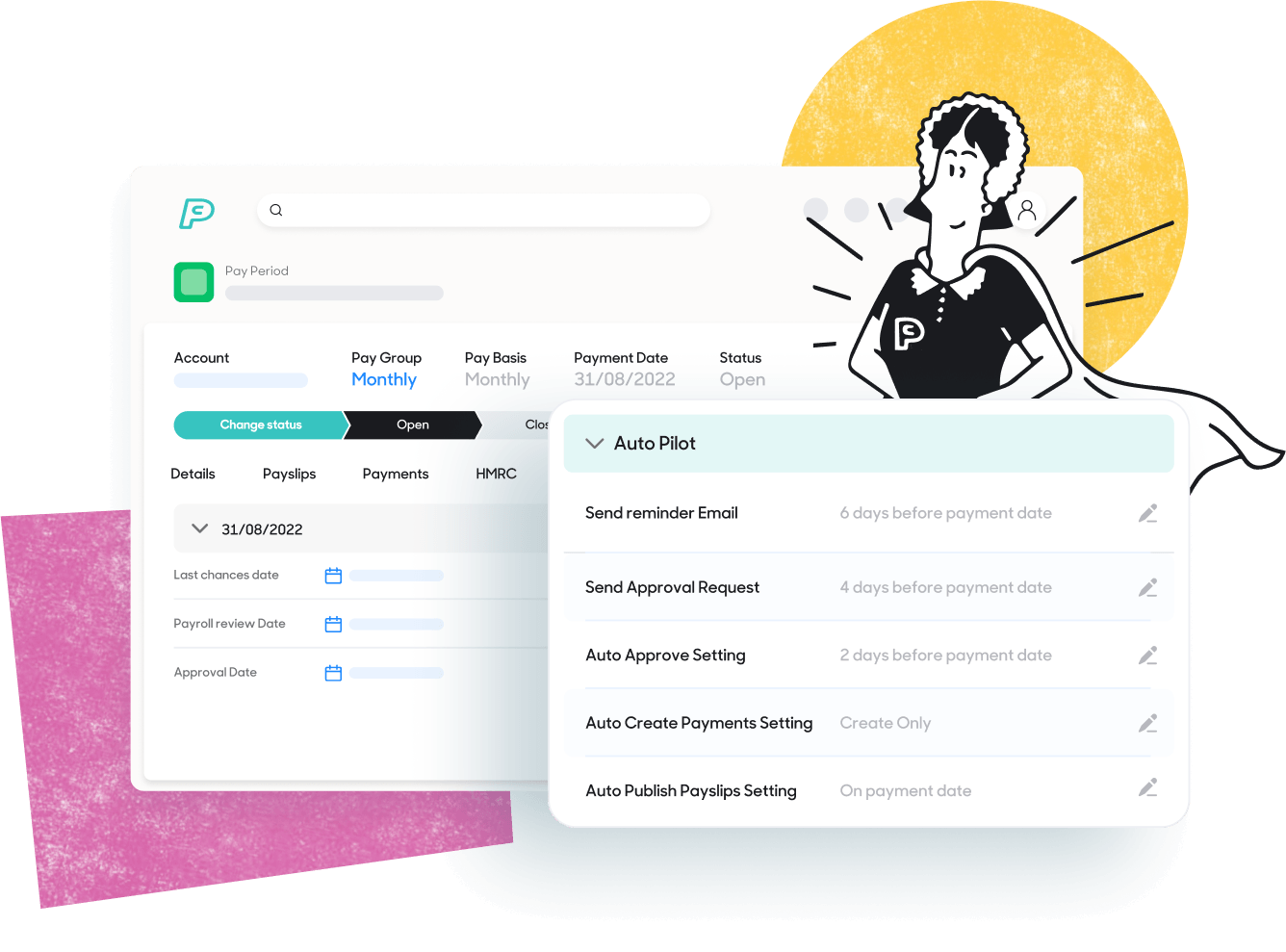
Good governance needs clear approval flows. Payroll technology helps by routing changes to the right approver. It also logs all recorded decisions and stops unauthorised actions. This reduces the risk of informal sign-offs close to pay day.
It also gives the organisation a clearer record of:
- who approved a change
- when approval happened
- what was approved
- whether any exception was raised
That makes approval control easier to evidence during reviews or audits.
Connecting payroll data across HR, finance and time systems
Integration is one of the biggest governance benefits of payroll technology. When payroll connects with HR, time, finance and payment systems, data can move through approved routes. Integrations reduce the need for duplicate entry. It also helps teams work from a more consistent record.
For large organisations, fragmented data makes governance harder. Teams can struggle to prove which figure was correct at a given point in time. Integrated systems make payroll data cleaner and easier to trace.
How payroll governance supports audit-ready reporting
Payroll technology also supports stronger reporting. Instead of building evidence after an audit request, teams can use system logs, exception reports and reconciliation outputs to provide evidence, ensuring payroll is always audit-ready.
It makes oversight more continuous, reducing the pressure on payroll teams when finance, audit or business leaders need answers.
Audit-ready reporting can help show:
- what changed
- who changed it
- when it changed
- who approved it
- how the issue was resolved
This evidence is what separates a controlled process from one that depends on memory.
Why payroll automation still needs governance controls
AI and automation support payroll review, but only when the data underneath is reliable. If fields are poorly mapped or data arrives late, automation can move errors faster. Strong governance still needs clear ownership and controlled data flows.
The best use of payroll technology is practical. It reduces manual work, strengthens evidence and helps teams focus on exceptions. It should make governance easier to live with, not harder to understand.
Reduce payroll risk with clearer controls and stronger evidence
Building scalable payroll governance for large organisations
Payroll governance needs to change as the organisation changes. New systems, entities and working patterns all affect payroll risk. Large organisations should treat governance as an ongoing process. The framework should be reviewed regularly and updated after major change. A system replacement, restructure or serious payroll incident should always trigger a review.
A useful way to think about this is payroll maturity. Low maturity payroll often has high error rates, unclear roles and undocumented processes. Medium maturity may have better tools, but still relies on unclear handoffs.
High maturity looks different. Roles are defined, processes are documented and payroll data connects with HR and finance. Errors are reviewed for root cause, rather than just corrected.
Moving to high maturity takes leadership commitment. Technology can help, but it can’t solve unclear ownership. Nor can it fix a process where teams don’t agree who approves what.
Governance also needs to cover third parties. Many large organisations use payroll bureaus, outsourced payroll providers or intermediary arrangements. Governance responsibility can’t simply be handed away and remains the legal responsibility of the employer.
Final thoughts from PayCaptain on payroll governance frameworks and what large organisations need in place
Payroll governance isn’t about slowing payroll down, but about making payroll easier to trust as the organisation grows.
Large employers need more than accurate calculations. They need:
- evidence that payroll is controlled, reviewed and owned
- to show how changes are approved and how risks are tracked
- to demonstrate how errors were identified and corrected
A payroll governance framework helps payroll, HR and finance work from the same model. It also gives business leaders better oversight of one of the organisation’s largest recurring financial processes.
For employees, the outcome is simple - they want to be paid correctly on time, every time. For finance and payroll leaders, the requirement is wider. They need a process that can stand up to scrutiny. Strong governance makes this possible. It reduces reliance on memory and supports better evidence, helping payroll scale without adding unnecessary risk.
Payroll should be accurate and controlled. The right technology can drive it forward, but strong internal payroll governance is what makes it dependable.
Use payroll technology to make governance easier to evidence