
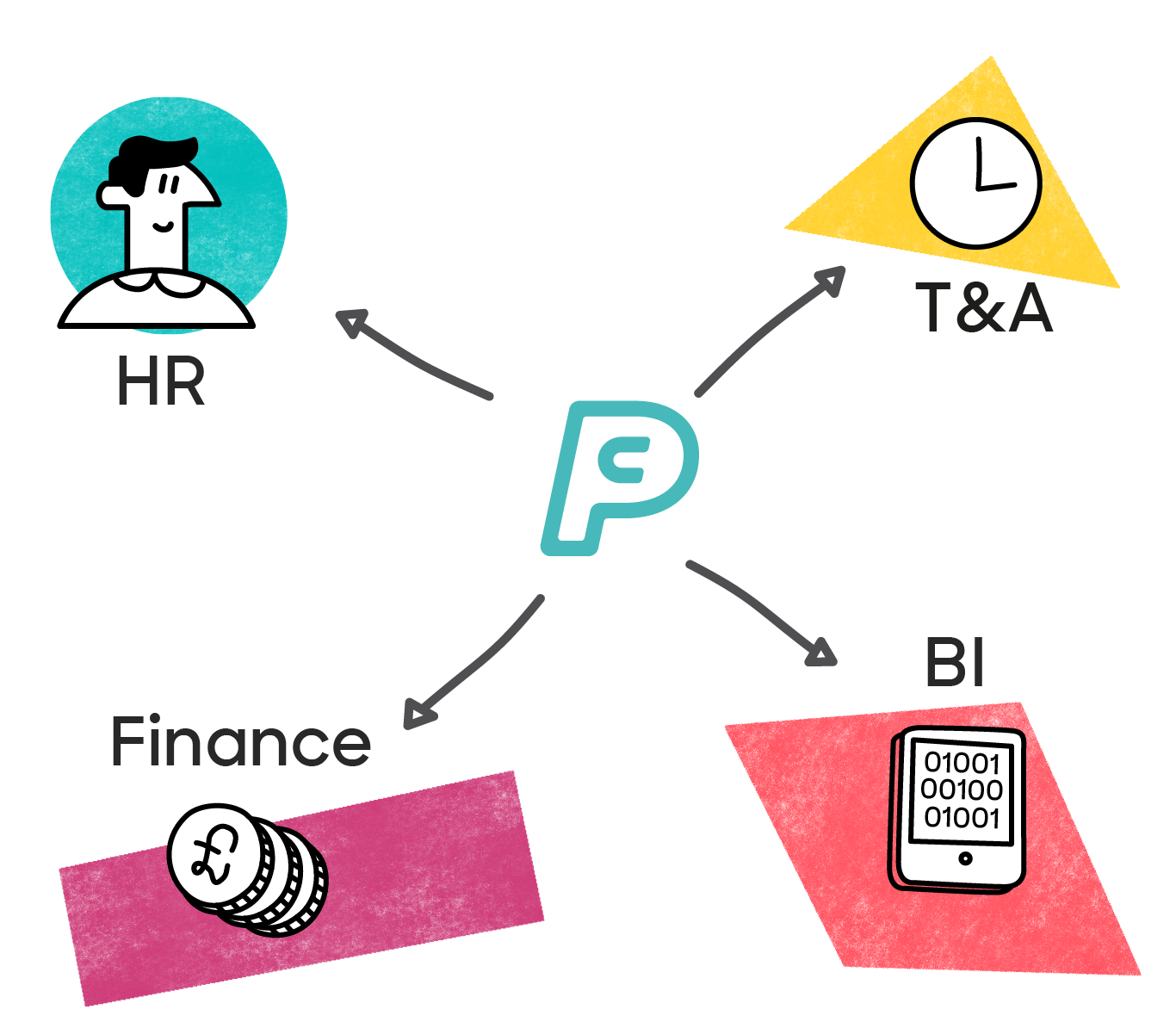


Payroll doesn’t sit alone. It connects HR systems, finance platforms and often time and benefits tools. If the connections between essential business systems are weak, risk can grow, errors can increase and trust can drop.
Integration isn’t just systems talking to each other. It’s controlled data flow between HR, payroll and finance:
- Each system needs a clear role
- Each handoff needs to be defined
- Each output needs to be trusted
Complexity is normal and multiple platforms are common. The aim isn’t to remove the complexity, it’s to govern it.
A strong payroll integration creates structure. Typically, HR owns people data, payroll owns calculation and finance owns reporting. When that structure is clear, data moves with purpose and control follows.
What payroll integrations mean in practice
Payroll integrations are often described as connections between systems. But connection alone isn’t enough.
In practical terms, payroll integrations mean:
• Systems sharing structured, consistent data
• Automated or scheduled transfer of data, not manual uploads or rekeying
• Clear ownership of each type of data
• Defined inputs and defined outputs
For example, HR holds employee master data. Payroll consumes that data to calculate pay. Finance receives structured outputs for payroll reporting and journals. Each system plays a specific role.
Uploading a spreadsheet each month is a workaround. These workarounds rely on memory and manual checks. They’re also time consuming and labour-intensive. They can be hard to audit effectively. Who changed what, when it changed or why they changed it can be hard to prove.
Integration connects systems. Controlled HRIS payroll integrations create accountability.
How payroll systems integrate with HR and finance
Most payroll integrations use one of the following patterns - APIs or controlled file exchanges, middleware and message queues. The right choice depends on timing needs, data volume and how many systems are involved.
APIs, application programming interfaces, don’t send data, but they expose an interface for internal or third parties to retrieve or send structured data through them. In PayCaptain’s case, we receive data via the PayCaptain API as well as polling data from HRIS and rota systems’ APIs.
HRIS systems can push events like hires, leavers and salary changes into payroll. Payroll can then send pay run status and key outputs for finance. This works best when the integration includes validation, retries and clear error messages.
There are a few common API designs:
• Point to point APIs between two systems, best for a small stack
• Webhooks, where HR sends a change event as it happens
• Scheduled API pulls, where payroll fetches approved data at set times
• An integration layer, which handles mapping, queuing and monitoring
File exchanges still exist for a reason. They’re widely supported and predictable. But they need strong controls, fixed templates, versioning and logged loads. Many teams use files as a fallback route, with APIs as the primary route.
Whatever method is chosen, reliability comes from the same design basics. The basics include:
- Defining the system of record for each field
- Agreeing effective dating rules and cut-offs
- Securing the connection with modern authentication and least-privilege access
- Monitoring interfaces and alerting on failed transfers, late data and unexpected volumes
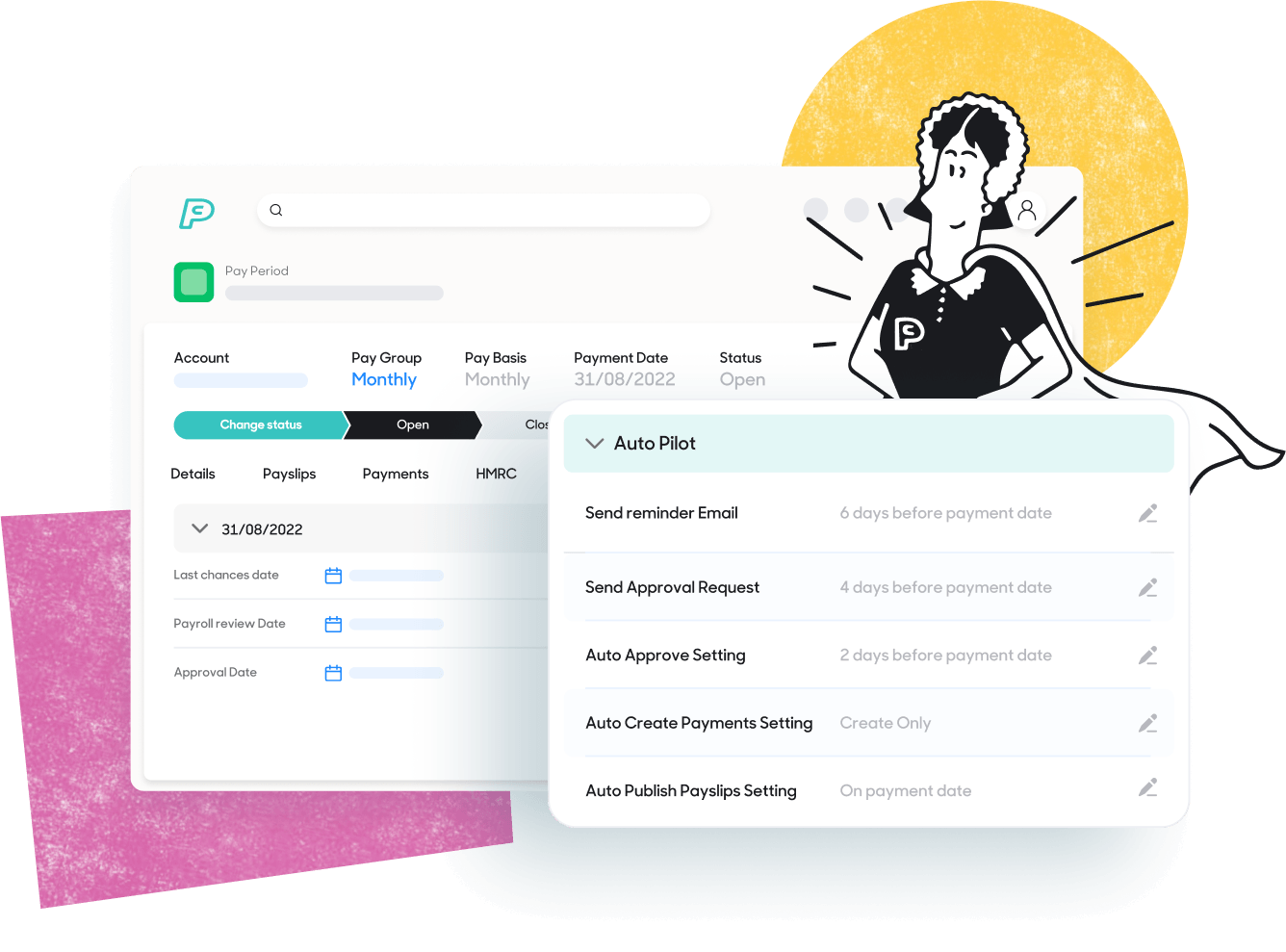
PayCaptain’s payroll software transmits data to integrated systems using APIs. They can run in real time or on a schedule, depending on the system and the use case.
Benefits of HRIS payroll integration for employers
When HR, payroll and finance share data through system integration, payroll teams reduce repeat work. HR changes can pass straight into payroll without re-keying. This cuts the chance of mismatch between systems and can save time and money by reducing manual or double entry.
Better data flow also improves payroll accuracy. If the same approved HR data feeds payroll each cycle, there are fewer moving parts. It supports cleaner processing and fewer corrections. PayCaptain links integrated HR and payroll to more timely and accurate data capture.
For finance, integration makes payroll costs easier to trust. Payroll outputs can be structured, consistent and ready for journals. Integration reduces period end queries and supports clearer variance review. It also supports audit work, since interface logs and validations give evidence of what moved, when and by who.
Common benefits you can expect from a well-controlled integration include:
• Less manual entry and fewer spreadsheet uploads
• More consistent employee data across systems
• Better validation of key fields, like bank details and NI numbers
• Faster handoffs between teams, since everyone sees the same updates
• Stronger governance, since employers still hold PAYE responsibility and need evidence of control
Talk to our payroll experts about HRIS payroll integration
Why payroll integrations need controlled data flow
Payroll data flow matters because payroll is a key risk area. It touches tax, cost and people. When data moves poorly between systems, the impact spreads quickly.
- Compliance accuracy. Payroll must reflect correct pay, tax codes and statutory deductions. If HR changes aren’t passed cleanly to payroll, errors follow. HMRC guidance states that employers remain responsible for accurate PAYE reporting, even when systems are integrated. Integration doesn’t remove liability but increases the need for control.
- Financial reporting integrity. Payroll is often one of the largest operating costs. Finance relies on accurate gross pay, employer contributions and cost centre splits. If payroll outputs don’t reconcile with the general ledger, forecasting and month end close suffer.
- Operational efficiency. Manual uploads, duplicate entry and spreadsheet checks consume time. It’s effort and time could be spent on review and oversight instead of correction.
- Employee trust. Incorrect or late pay damages confidence quickly. A clean data flow reduces avoidable mistakes.
This is where the idea of a single source of truth appears. It shouldn’t mean one giant database but should mean defined system ownership.
- HR owns people data
- Payroll owns calculation
- Finance owns reporting
Each system is authoritative for its domain. Data flows between them in a controlled and auditable way.
What data should move from HR to payroll systems
HR should be the starting point for most payroll inputs. It’s where people data is created and changed. Payroll should consume that data, then calculate pay from it.
The key is ownership and timing. HR owns the truth for employee records. Payroll relies on that truth being complete and up to date before each pay run.
Data that should move from HR to payroll includes:
• Employee identity data: legal name, address, date of birth, NI number
• Employment details: start date, leaving date, contract type, working pattern
• Pay terms: salary or hourly rate, pay frequency, overtime rules, allowances
• Job and org data: job title, manager, department, location, cost centre
• Change events: promotions, salary changes, contract updates, unpaid leave
• Statutory status signals: maternity, paternity, sickness dates and return dates
• Benefits and deductions setup: pensions enrolment, salary sacrifice flags, loan plans
Timing matters as much as the fields. HR changes should flow as controlled events, with an audit trail. HMRC recognised payroll software should validate what it receives before calculation. If something fails validation, it should route back to HR for correction, not get patched in payroll.
What data should payroll pass to finance?
Payroll should be the source for pay results. Finance shouldn’t have to rebuild numbers from payroll reports. It should receive structured outputs that can post cleanly into the ledger.
Payroll owns calculation. Finance owns reporting and control. The handoff between them needs to be consistent every period.
Data payroll should pass to finance includes:
• Gross pay totals by entity, department and cost centre
• Employer costs: NIC, pension contributions, apprenticeship levy where relevant
• Statutory payments and recoveries, shown clearly as separate lines
• Benefit costs and deductions, split between employer and employee where needed
• Payroll liabilities: PAYE, NIC, pensions and other withholdings due
• Net pay totals for bank funding and cash flow planning
• Payroll journals in the format finance needs, including mapping to GL codes
• Variance outputs, such as changes vs last period, to support review
Reconciliation is part of the flow. Finance should be able to reconcile payroll totals to posted journals, then to cash movements and statutory liabilities. When the data is structured and consistent, reconciliation becomes a control step rather than a monthly investigation.
See our integrations in action
Common structural challenges in payroll integrations
Payroll data moves across systems with different purposes and different data models. The mismatch can create design pressure.
A key design question is the system of record for each data item. HR usually holds personal details and contract terms, whereas payroll holds pay elements and statutory settings. Finance usually holds cost centres and ledger codes.
- Employers need a clear process for who can change each field. If ownership is not defined field by field, each system becomes a partial master.
- Identity management is part of the same problem. Systems may use different employee IDs, or reuse IDs after rehiring. The HRIS payroll integration needs a stable matching key and rules for changes over time. Without that, there’s the risk of paying or posting costs to the wrong record.
- Timing is another structural constraint. HR changes arrive as events, while payroll runs to cut offs and scheduled cycles. Internal teams need clear rules on latency, retries and duplicate events. They also need an audit trail for each change.
- Effective dating adds complexity. A change can be entered today but apply to last month. Payroll then creates arrears, while finance must post to the right period. There needs to be agreed rules for back-posting and journal adjustments.
- Interface choices add further complexity. File transfers are simple to start with. But they depend on formats, delivery times and manual handling. An interface layer can enforce schemas, validation and version control.
- Reconciliation between payroll and finance is also a design topic. Payroll outputs must map to accounts, cost centres and periods. Mapping rules need one controlled home, with change logs and testing. Controls such as pay run IDs, automatic cross-checking column totals and balancing journals make gaps visible early.
How to design a reliable payroll data flow
A reliable payroll flow starts with clear boundaries between HR, payroll and finance. Each system should own defined data, and only that system should write it. Internal teams should agree a shared data dictionary so fields mean the same across the organisation. This reduces drift when processes change or vendors update products.
Handoffs should be defined as formal data contracts, not informal exports. Organisations should set out formats, effective dates, cut-offs, validation rules and how corrections are handled. Transfers should be automated where possible, using APIs or managed integration services with version control. If files remain necessary, they should be scheduled, templates should be locked and every load should be logged.
Audit checks should sit inside the flow at each step. Record counts, column totals and run IDs help confirm the same data arrived. Payroll outputs should reconcile to journals, then to bank payments, with clear tolerances and named owners. Evidence of exceptions, approvals and fixes should be kept for audit and troubleshooting.
Integration integrity should be reviewed regularly, especially after policy, mapping or security changes. Known edge cases, such as rehires, backdated changes and retro pay, should be tested each cycle or release. The flow should be treated as a controlled process, supported by change management and clear reporting.
What good payroll integrations look like in practice
Good payroll integrations should feel ‘quiet.’ Data moves without chasing, re-keying or last-minute fixes. Teams spend time checking exceptions, not rebuilding files.
Each system shows the same truth at the right time.
With good payroll integrations, organisations tend to see these outcomes:
• HR changes are captured once at source, then flow to payroll and finance automatically. Hires, leavers, salary updates and cost centre changes follow the same route each time. Late or rejected updates are flagged with a reason and a named owner.
• Payroll journals reconcile cleanly each period. Totals balance from gross to net, then match the general ledger posting. Suspense lines are rare and are explained when they appear.
• Finance teams trust payroll cost reporting. Labour costs land in the right cost centres and periods, including arrears and backdated changes. Month end close becomes more predictable because payroll timing and posting rules are stable.
• Manual adjustments reduce. Genuine exceptional cases still exist, but routine mismatches between systems fall away. Spreadsheet bridges and hand-built uploads become less common.
• The audit trail is more complete. A pay result can be traced back to the HR event, approvals and interface logs. It’s also possible to evidence what changed, when it changed and who made the change.
The key sign is confidence. People stop asking which number is right, because the flow answers the question for them.
See how data is passed quickly and easily from Bamboo HR to PayCaptain
Final thoughts from PayCaptain
Payroll integration starts with a connection, but it only works with governed data flow. This means clear ownership, clear handoffs and controls that can be evidenced. When HR, payroll and finance stick to their roles, the flow stays stable. When roles blur, delays and mismatches can be seen, which requires extra checking.
Employers should start with payroll basics - a data dictionary and a named system of record for every field. Then handoffs should be defined as data contracts, including timings, effective dates and what happens on failure. The movement of data should be automated. Reconciliation should be built into the routine, so finance can post with confidence each period.
A simple checklist for system integration:
• Organisations should map the full journey, from HR change to pay result to journal
• They should agree keys, cut-offs and backdated change rules before building
• They should add checks, counts, column totals and clear ownership for exceptions
• They should review alerts, mappings and access after each change and at least quarterly
When the flow is designed this way, payroll becomes easier to run and trust. It also becomes easier to prove control, which matters in audits and when queries arise.
Talk to our payroll experts about payroll integrations
.png)

