

Multi-entity payroll is one of the clearest signs that payroll has moved beyond routine processing. It isn’t just a bigger version of standard payroll. The complexity comes from legal structure, reporting duties and control. Every entity can have its own employer obligations, payroll records and HMRC requirements.
For large organisations, this creates a difficult balance. Payroll teams need to manage each entity correctly. Finance teams also need a single group view of payroll costs, risk and reporting. This is why multi-entity payroll needs more than careful administration. It needs strong governance, connected data and payroll technology that can support complexity without hiding it.
Explore how PayCaptain can support complex payroll structures across multiple entities
What is multi-entity payroll?
Multi-entity payroll is the management of payroll across two or more separate legal entities within the same organisation.
This might include a holding company with several subsidiaries. It can also apply to groups built through acquisition, public sector bodies, joint ventures, franchise groups or multi company payroll structures. The key point is legal separation. Each legal entity is treated as a separate employer.
In the UK, each separate employer usually needs its own PAYE scheme and Employer Reference Number. One entity can’t simply share another entity’s PAYE scheme because the group has common ownership.
This is where multi-entity payroll starts to differ from standard payroll.
A large single-entity enterprise employer may have many employees, sites and shift patterns. Their payroll can still be complex. But multi-entity payroll adds a different – and additional - layer. It means payroll teams must manage separate employer records, reporting duties and compliance controls.
How multi-entity payroll works in practice
Multi-entity payroll can include:
- separate PAYE schemes across the same corporate group
- employees moving between legal entities
- shared employees working across different entities
- group-level payroll reporting for finance teams
- intercompany payroll cost recharges
- different approval flows by entity
- entity-level year-end reporting
The term multi company payroll is often used. It usually describes payroll across more than one company within a wider group.
For global groups, the same principle can extend into a wider global payroll structure. Each country brings its own tax, social security and employment rules. The legal employer still matters.
Why multi-entity payroll is more complex than standard payroll
Multi-entity payroll becomes more complex because each entity carries its own duties.
The organisation may think as one group, but HMRC doesn’t treat it that simply. Each legal employer must still be managed correctly.
Each entity has separate reporting duties
Every PAYE scheme must meet its own Real Time Information duties. This includes Full Payment Submissions (‘FPS’) on or before payday.
Each entity must also maintain its own payroll records. Where no employees are paid, the correct reporting may still be needed. This creates a repeated compliance burden:
- One deadline becomes several
- One payroll calendar becomes many
- One year-end process becomes separate entity-level processes
This is manageable when processes are strong, but becomes risky when payroll relies on manual checks and local workarounds.
Employees can move between entities
Employee movement is a major source of complexity.
An employee may move from one legal employer to another. In this case, payroll teams need to manage leaving and starting details correctly. Year-to-date figures may need to restart under the new employer reference.
Other employees may work across more than one entity at the same time. This can raise questions around National Insurance aggregation and reporting.
The risk isn’t only technical, but also operational. If HR, payroll and finance don’t share the same view, the wrong entity may carry the wrong cost or report the wrong data.
Costs may need to be reallocated between entities
Many groups use shared teams. An employee may be employed by one entity but work for another.
When this happens, payroll cost allocation needs proper control. Finance teams may need to recharge costs between group companies on a reasonable basis. This turns payroll data into finance data. It affects management accounts, cost reporting and tax treatment.
So multi-entity payroll isn’t only a payroll issue. It sits between payroll, HR, finance and compliance.
See how better payroll technology can support your multi-entity payroll model
The biggest operational challenges in multi-entity payroll
The main challenges in multi-entity payroll rarely appear all at once. They usually build over time:
- A group acquires a company
- A new payroll process is added
- A local team keeps its own spreadsheet
- A finance report needs manual adjustment
The process still works. Until it doesn’t.
Fragmented payroll data creates risk in multi-entity payroll
Data fragmentation is one of the biggest problems in multi company payroll. Different entities may use different systems and hold data in different formats. Some may rely on manual uploads. Others may use spreadsheets to bridge gaps between HR, time systems and payroll, which makes it hard to create one reliable group view.
It also increases the risk of payroll errors. Manual rekeying creates more chances for mistakes. Disconnected systems make errors harder to spot before payment.
Why governance gaps create risk in multi-entity payroll
Payroll governance defines who can change data, who approves it and how checks are evidenced.
In multi-entity payroll, weak governance can spread quickly. Each entity may have its own habits. Some processes may be documented. Others may sit in people’s heads.
The risks include:
- unclear ownership between HR, payroll and finance
- weak approval controls
- inconsistent checks by entity
- poor audit trails
- delayed issue reporting
- too much reliance on key individuals
Managing these risks is critical because payroll is a control function. It handles money, tax and employee trust.
Separate HMRC reporting across schemes
Each PAYE scheme needs its own compliance rhythm. This includes for RTI submissions, year-end reporting and benefits reporting where relevant. Where mergers, successions or restructures happen, payroll teams need to manage the sequence carefully.
Small errors can quickly escalate. Duplicate records, missing submissions or incorrect employee movements can all affect HMRC data.
Why HMRC reporting becomes harder across multiple PAYE schemes
Finance leaders need a group-level view. They need to understand total payroll cost by entity, function, location or business unit. They may also need reports for budgeting, audit, workforce planning and board reporting. A clean overview can be difficult when entity-level payroll data sits in separate systems.
Without a structured reporting model, payroll teams can spend too much time building reports manually, reducing time for control, review and improvement.
Speak to PayCaptain about reducing manual work across your payroll process
How large organisations structure multi-entity payroll
There isn’t one perfect model for multi-entity payroll. The right structure depends on the size of the group, its entity mix, its risk profile and its wider finance model. But most organisations use one of three approaches:
Centralised payroll for multi-entity organisations
In a centralised model, one payroll function manages payroll across all entities. This can create stronger control. Processes can be standardised. Reporting can be more consistent. Governance can also sit under one senior owner.
The challenge is knowledge. The central team still needs to understand each entity’s PAYE scheme, workforce rules and reporting needs.
Centralisation doesn’t remove entity-level duties but helps the organisation manage them in a more consistent way.
Decentralised payroll in multi-entity organisations
In a decentralised model, each entity or business unit runs its own payroll. This can suit organisations with very different local needs. It may also happen after acquisitions, where each business keeps its existing process.
The weakness is group visibility. Controls may vary by entity. Reporting may be harder to combine. Payroll teams may duplicate work across the group.
Decentralised payroll can work, but it needs strong oversight. Without it, the group may not see risk until something has already gone wrong.
Shared payroll services for multi-entity organisations
Many large organisations move towards a shared payroll service. This gives the group one governed payroll function while still recognising entity-level PAYE duties. It can support consistent processes, stronger reporting and better query management.
A shared service model can also align payroll more closely with HR and finance as multi-entity payroll depends on accurate data handoffs.
The strongest models keep entity compliance separate but manage oversight centrally.
Bring payroll, reporting and employee support into one smarter platform
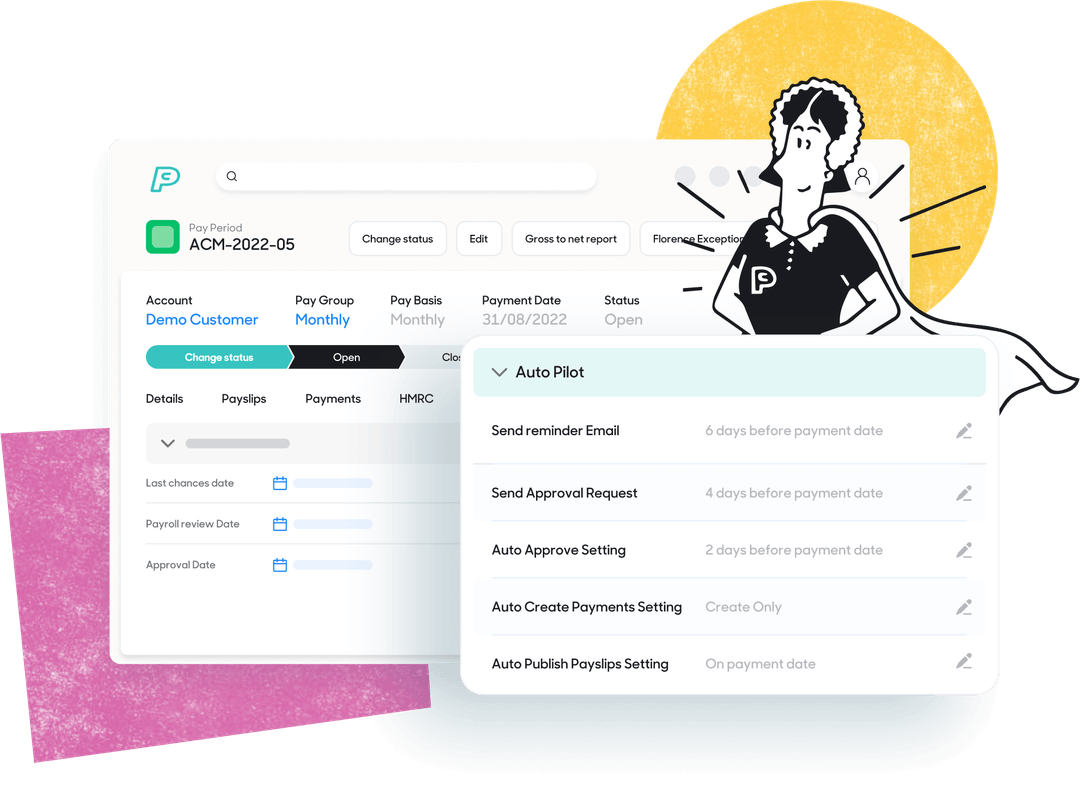
How payroll platforms support multi-entity payroll
Payroll technology can’t fix poor governance on its own – a weak process inside a better system is still a weak process. But the right payroll platform can make multi-entity payroll easier to control, check and report. Technology should help payroll teams manage legal separation without creating operational separation.
What payroll platforms need to support
A payroll platform used for multi-entity payroll should help organisations manage:
- separate PAYE schemes
- entity-level RTI submissions
- group-level payroll reporting
- employee movement between entities
- shared employee records where needed
- audit trails and exception reports
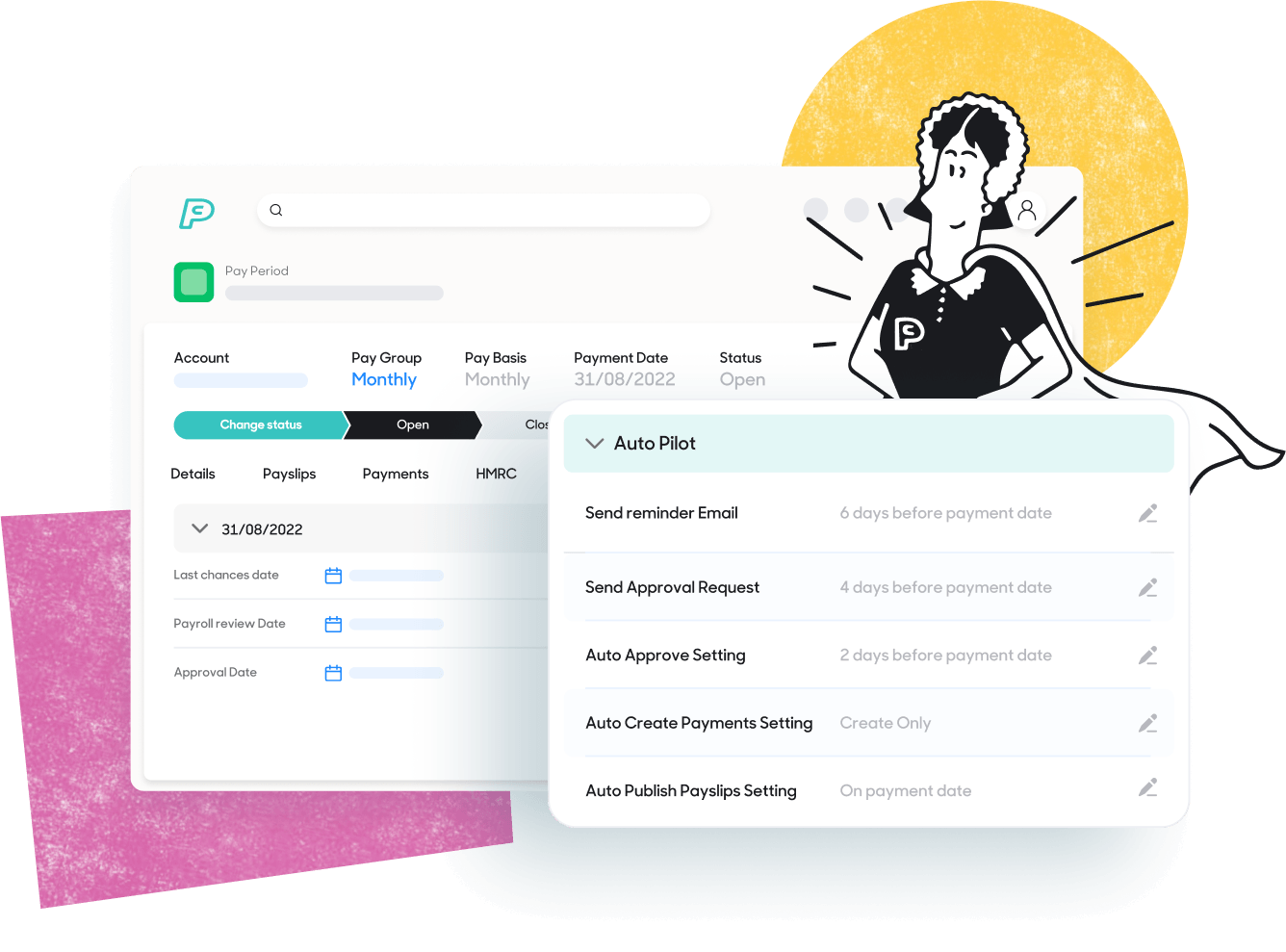
- approval workflows
- integrations with HR, time and finance systems
This is particularly important for enterprise payroll. Larger groups need both detail and oversight. Entity data must stay distinct where compliance requires it. Group data must still be available for finance and decision-making.
Why integration matters in multi-entity payroll
Manual data movement is a serious risk in multi-entity payroll
- If HR changes are keyed into payroll by hand, mistakes become more likely
- If finance reports are rebuilt manually, numbers can drift
- If time data isn’t connected, payroll teams spend too much time checking inputs
Integrated systems reduce these risks. They also give payroll teams better evidence. There’s a clearer trail from source data to payroll output, which makes review, approval and audit easier.
Why reporting matters in multi-entity payroll
A good multi-entity payroll platform should help teams see both levels of the picture.
Payroll teams need entity-level detail. Finance teams need consolidated reporting. Senior leaders need confidence that payroll cost is accurate and controlled.
This is where payroll technology should make complexity visible. It shouldn’t flatten every entity into one view. It should allow each entity to be managed correctly while giving the group a reliable overview.
Best practices for multi-entity payroll management
The strongest multi-entity payroll functions don’t rely on heroic effort. They use clear structures, documented controls and connected systems. They reduce manual work where possible and make accountability visible.
Map each employee to the right entity
Every employee should be clearly linked to the correct legal employer. Their contract, PAYE scheme and payroll record should align. Where employees work across entities, the arrangement should be documented before payroll is processed. This reduces confusion around reporting, costs and statutory deductions.
Entity mapping should also be reviewed after acquisitions, restructures or TUPE transfers. These are moments where payroll risk can rise quickly.
Manage PAYE schemes separately but govern them together
Each PAYE scheme needs its own compliance calendar. This should include for RTI submissions, payment deadlines and year-end tasks. These can’t be treated as one combined obligation.
Governance should still sit across the group.
A central payroll owner should understand the full position including intercompany recharges, Employment Allowance decisions, NIC aggregation issues and consolidated reporting. This is the balance at the heart of multi-entity payroll - separate compliance and shared oversight.
Remove manual data flows
Manual work creates repeat risk.
This is especially true when payroll teams manage multiple entities. One manual step repeated across ten entities is ten opportunities for error.
Organisations should look closely at:
- spreadsheet uploads
- manual report building
- repeated data entry
- email-based approvals
- untracked payroll changes
These are often signs that the process has outgrown its controls.
Keep approval workflows clear
No one person should control the whole payroll process. HR changes, payroll calculations, exception reviews and payment approvals should have named owners. And the process should be documented.
This applies at entity level and group level. It’s especially important when payroll costs are recharged between entities. Finance needs confidence that the right costs sit in the right place.
Plan for legislative change
UK payroll rules change often.
Rates, thresholds, statutory payments and reporting requirements all need review. In multi-entity payroll, every change may need to be applied across several PAYE schemes.
Good payroll teams plan for this. They build change into the payroll calendar. They test changes before live payroll runs and check that each entity has been updated correctly.
Use exception reporting
Exception reporting helps payroll teams find issues before they become payment problems. This might include unusual pay movements, missing data, duplicate records or changes outside normal patterns. For multi company payroll, exception reporting is especially useful. It gives teams a way to review risk across entities without checking every line manually.
Build a global payroll structure with local control
For groups operating beyond the UK, global payroll structure becomes a wider governance question. The group needs consistent oversight. Local entities still need to meet local rules. Payroll should be designed so local compliance is protected while group reporting remains reliable.
This means clear ownership, connected data and documented controls.
Final thoughts from PayCaptain on multi-entity payroll
Multi-entity payroll is complex because the legal employer matters. Each entity brings its own payroll duties, records and reporting needs. As organisations grow, these duties become harder to manage through manual processes.
The risk is not only late or incorrect pay. It’s weak oversight, poor reporting and hidden compliance gaps.
Good multi-entity payroll management starts with the right structure. Each entity needs to be mapped and governed correctly. Payroll, HR and finance need clear handoffs. The platform supporting the process needs to make complexity easier to manage.
Explore PayCaptain’s award-winning payroll